


L-Theanine Bulk Sourcing: Chiral HPLC Enantiomeric Purity, Production Routes, and Beverage Synergy
Qualifying bulk L-theanine requires separating stereochemical enantiomeric purity (L- vs. D-isomer) from generic 99% HPLC assay claims while auditing production routes for residual solvents and regulatory compliance. Uncontrolled chemical synthesis and harsh thermal extraction can produce racemic DL-theanine mixtures containing unnatural D-theanine, which lacks targeted neuro-cognitive affinity.
Pharmaceutical and functional beverage formulators verify genuine L-theanine (CAS 3081-61-6) using chiral chromatography and optical rotation ([α]D20 −8.0° to −11.5°), paired with enzymatic biocatalysis or fermentation documentation. In nootropic and sleep applications, L-theanine delivers validated synergy alongside caffeine (1:1 / 2:1 ratios) and GABA/magnesium matrices across stable beverage pH windows (pH 3.0–6.5).
Written by Blueeyes Bio Technical Content Team
Publisher: Blue Eyes Biotech Co., Ltd.
Technical scope: enantiomeric chiral HPLC separation, biocatalytic green synthesis, and functional beverage stability.
1. The Chiral Reality: Why Generic "99% Purity" Is an Incomplete Specification
In the global dietary supplement and beverage manufacturing sectors, procurement managers frequently source bulk amino acids and vitamins supplier materials based solely on standard C18 reverse-phase HPLC certificates of analysis (COAs) stating “≥ 99.0% Purity.” For L-theanine (γ-glutamylethylamide, CAS 3081-61-6), this creates a major quality vulnerability.
Standard achiral HPLC methods separate theanine from unrelated amino acids and residual synthesis precursors, but they cannot resolve enantiomers. Conventional achiral chromatography elutes L-theanine and its unnatural mirror image, D-theanine, as a single overlapping peak. A raw material batch containing 50% D-theanine can generate a deceptive “99% HPLC assay” reading.
Why does enantiomeric purity matter to formulation scientists?
- Biological Receptor Affinity: Only the natural L-enantiomer crosses the blood-brain barrier via the leucine-preferring system and functions as a competitive glutamate receptor antagonist to modulate GABAergic transmission. D-theanine exhibits significantly lower uptake affinity and minimal neuro-relaxant activity.
- Adulteration Risks: Non-stereoselective chemical synthesis produces racemic DL-theanine at substantially lower cost. Furthermore, prolonged exposure of botanical green tea extracts to high extraction temperatures (> 80°C) causes thermal racemization, converting natural L-theanine into D-theanine.
- Definitive Chiral Verification: Quality assurance departments must mandate chiral ligand-exchange HPLC or pre-column optical derivatization alongside specific optical rotation measurement ([α]D20 = −8.0° to −11.5°, c=5 in H2O) to establish 100% enantiomeric excess (≥ 98.0% L-theanine).
2. Sourcing Matrix: The Four Commercial Production Routes
Formulators must align the manufacturing origin with brand clean-label positioning, regional regulatory compliance (US FDA GRAS vs. EU Novel Food), and cost targets:
| Manufacturing Route | Typical Enantiomeric Purity | Solvent & Residual Profile | Regulatory & Application Fit |
|---|---|---|---|
| Enzymatic Biocatalysis (Preferred) | ≥ 98.0%–99.5% pure L-enantiomer; chiral stereoselectivity via glutaminase / GGT enzymes. | Aqueous biocatalysis; tightly controlled ethylamine (< 10 ppm); zero Class 1/2 organic solvents. | US FDA GRAS compliant; gold standard for functional beverages, dietary supplements, and clean-label nootropics. |
| Microbial Fermentation (Engineered) | ≥ 98.0% L-theanine from bacterial fermentation (e.g., engineered E. coli platforms). | Aqueous fermentation broth; requires strict host-cell protein and endotoxin clearance testing. | Rapidly scaling cost-effective route; ongoing FDA GRAS notifications; ideal for high-volume functional food applications. |
| Botanical Water Extraction | Natural L-form, but prone to partial thermal racemization if dried under harsh conditions. | Pure water/ethanol extract from Camellia sinensis; co-extracts residual catechins and caffeine. | Certified Organic & 100% natural label claims; limited commercial supply and higher cost per active kg. |
| Chemical Synthesis (Racemic) | Racemic DL-theanine (approx. 50% L / 50% D) unless expensive chiral resolution agents are applied. | Requires screening for residual ethylamine, halogenated intermediates, and synthesis byproducts. | Lowest raw cost; strictly scrutinized under FDA cGMP; prohibited in natural-certified brands. |
For manufacturers formulating comprehensive green tea matrices, integrate our validated active grades of cosmetic grade green tea extract to capture complete botanical polyphenol and catechin benefits.
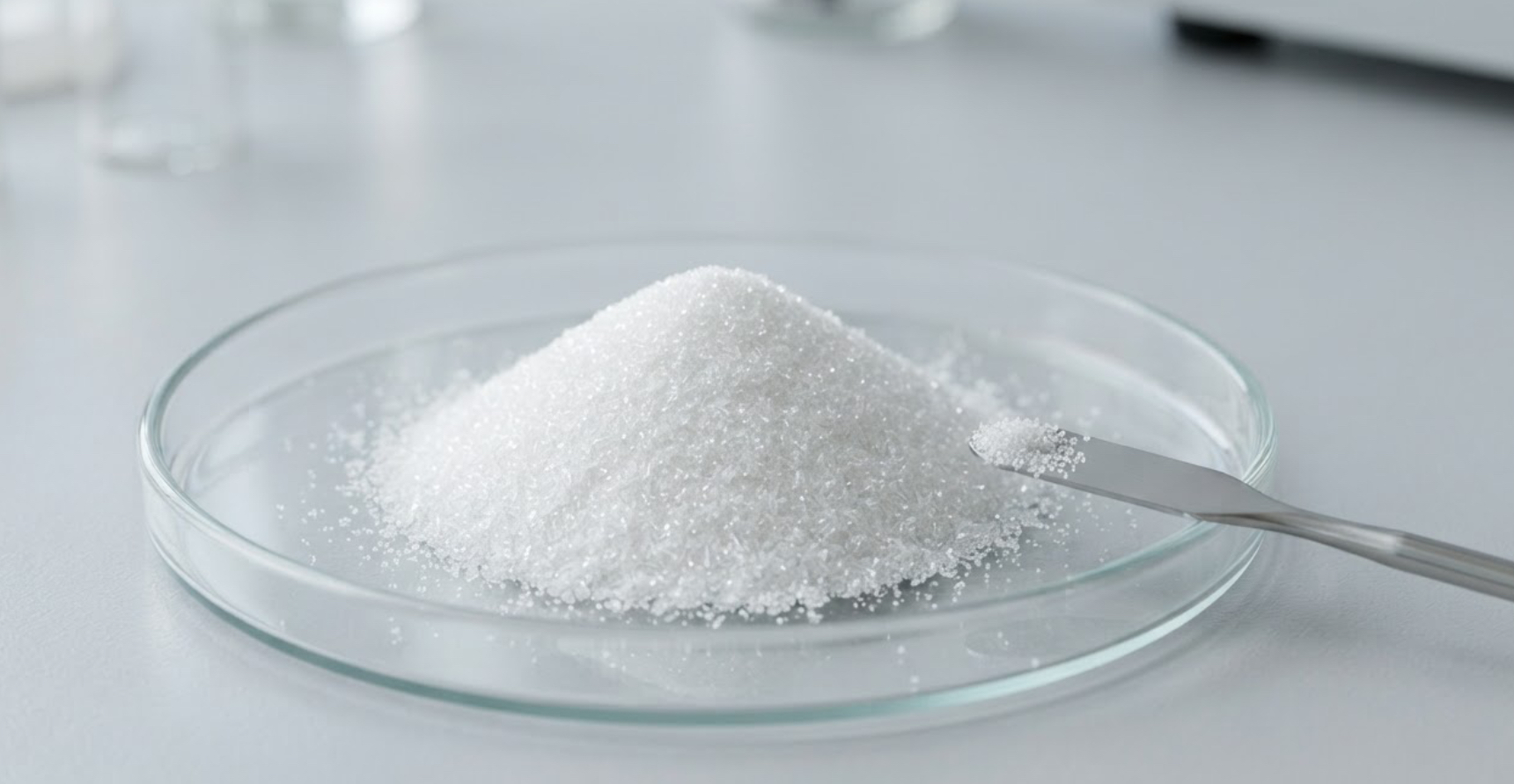
Figure 1: Visual appearance, uniform crystalline morphology, and fine mesh particle quality of bulk USP/FCC grade L-theanine powder.
3. Nootropic & Sleep Beverage Formulation Synergy
L-Theanine has emerged as the premier non-drowsy relaxant and cognitive enhancer in ready-to-drink (RTD) functional beverages, clean energy drinks, and sleep shots. Formulators leverage two primary pharmacological synergies:
A. The Clean-Energy Cognitive Engine (L-Theanine + Caffeine)
Anhydrous caffeine triggers central nervous system stimulation by blocking adenosine A1/A2A receptors, frequently accompanied by vasoconstriction, elevated heart rate, and an abrupt post-consumption “crash.”
Co-administering L-theanine at a 1:1 or 2:1 ratio (typically 100 mg–200 mg L-theanine to 100 mg caffeine) selectively increases alpha-band brain wave activity (8–12 Hz). This promotes a state of “relaxed alertness,” smoothing out caffeine-induced jitters, reducing blood pressure spikes, and extending mental stamina.
B. Neurotransmitter Modulation for Sleep & Cortisol Support
In nighttime recovery formulations, L-theanine facilitates sleep onset not through crude sedation, but by dampening systemic sympathetic stress responses. Formulators combine L-theanine with synergistic inhibitory actives within our sleep and mood regulation ingredient solutions portfolio:
- L-Theanine (200 mg) + GABA (100 mg): Cross-talk between glutamatergic antagonism and direct GABAA receptor activation accelerates sleep latency.
- L-Theanine (150 mg) + Magnesium Bisglycinate (200 mg): Synergistic NMDA receptor stabilization reduces nocturnal cortisol elevation.
- Thermal & Acidic Stability: L-Theanine exhibits exceptional thermodynamic stability in aqueous beverage matrices. It withstands standard HTST pasteurization (85°C–90°C for 15–30 seconds) and UHT processing (135°C for 3–5 seconds) without degradation, retaining 100% active recovery across pH 3.0 to 6.5 over 18-month ambient shelf life trials.
Figure 2: Complete cold-water dissolution and optical transparency of L-theanine for nootropic and functional beverage formulation.
4. Quality Control & Sourcing Specifications (USP / FCC / Ph. Eur.)
Procurement directors and quality assurance managers auditing bulk L-theanine manufacturers must enforce pharmacopoeial testing standards to eliminate industrial adulteration and ensure batch consistency:
| Quality Parameter | USP / FCC Pharmacopoeial Standard | Analytical Verification Method |
|---|---|---|
| Assay Purity (Dry Basis) | 98.0% – 102.0% L-Theanine. | Reversed-phase HPLC-UV at 210 nm with calibrated reference standards. |
| Specific Optical Rotation | [α]D20 = −8.0° to −11.5° (c = 5 in H2O). | Photoelectric polarimeter at 589 nm sodium D-line; detects gross racemic DL contamination. |
| D-Theanine Enantiomeric Limit | ≤ 1.0% (Chiral HPLC). | Chiral column chromatography (e.g., Chirobiotic T / Crownpak CR(+) HPLC). |
| Heavy Metals (Toxic Elements) | Lead < 0.5 ppm; Arsenic < 0.5 ppm; Cadmium < 0.1 ppm; Mercury < 0.05 ppm. | Inductively Coupled Plasma Mass Spectrometry (ICP-MS), fully Prop 65 compliant. |
| Residual Ethylamine / Solvents | Residual ethylamine < 10 ppm; meets USP <467> Class 3 limits. | Headspace Gas Chromatography (GC-HS). |
| Physical Solubility | Soluble in cold water (approx. 50 g/L at 20°C); clear, colorless solution. | Visual appearance in 5% aqueous solution; zero turbidity. |
Request Free 100g Pilot Samples, Chiral HPLC COAs & MSDS Dossiers
Blueeyes Bio supplies high-purity, enzymatically derived L-theanine (≥ 98.5% chiral purity) produced under certified ISO 22000, HACCP, and cGMP standards with full Halal, Kosher, and US FDA GRAS compliance. Submit your functional beverage or supplement formulation targets to request a free 100g R&D trial sample, batch-specific chiral HPLC analysis, and comprehensive MSDS safety documentation.
Request 100g L-Theanine Sample via WhatsApp
Email: [email protected]
Commercial bulk quantities (25 kg fiber drums with double-lined polyethylene bags), pallet-tier logistics, and OEM custom premixes available upon consultation.
Frequently Asked Questions
Why does cheap bulk theanine often fail chiral HPLC testing?
Low-cost theanine is frequently manufactured via non-stereoselective chemical synthesis, producing a 50:50 racemic mixture of L- and D-theanine. Standard achiral HPLC cannot distinguish these optical isomers and reports a false 99% purity. Only chiral chromatography reveals unnatural D-theanine contamination.
Is L-theanine stable in acidic hot-fill beverages?
Yes. L-Theanine possesses exceptional chemical resilience in liquid matrices. It does not hydrolyze or degrade across pH 3.0 to 6.5, even when subjected to industrial pasteurization (85°C–90°C) or UHT thermal shock, making it ideal for clean-energy drinks and RTD teas.
What documents must buyers audit before purchasing commercial L-theanine?
Buyers must require a batch-specific Certificate of Analysis (COA) containing chiral HPLC enantiomeric data (≤ 1.0% D-theanine), specific optical rotation, residual ethylamine levels (< 10 ppm), heavy metal ICP-MS quantification, and a formal Material Safety Data Sheet (MSDS).
References and Regulatory Evidence
[1]Desai MJ, Armstrong DW. “Analysis of commercial L-theanine products by HPLC and chiral chromatography.” Journal of Chromatography A, 2004. Identifies widespread presence of D-theanine in synthetic commercial preparations.
[2]United States Pharmacopeia (USP) / Food Chemicals Codex (FCC). Official Monograph: L-Theanine. Purity criteria, optical rotation, and chromatographic impurity limits.
[3]Hidese S, et al. “Effects of L-Theanine Administration on Stress-Related Symptoms and Cognitive Functions in Healthy Adults: A Randomized Controlled Trial.” Nutrients, 2019.
Evidence limitation: Technical specifications represent Blueeyes Bio standard commercial grade parameters and peer-reviewed scientific studies. Finished product regulatory status, label structure/function claims, and cognitive efficacy depend on the complete dosage matrix and destination market legal frameworks.
Technical Summary
Blueeyes Bio supplies enzymatically derived L-theanine (≥ 98.0% assay, ≥ 98.5% chiral purity) free of synthetic D-theanine adulteration. With verified optical rotation, low heavy metals, and proven thermal stability in acidic RTD beverages, formulators achieve dependable synergistic cognitive and sleep-enhancing health products.


