


Qualifying a hydrolysed tuna collagen peptide supplier means checking seven things: species and body part, average molecular weight with its full distribution, protein on a stated basis, hydroxyproline as an identity marker, individual ICP-MS results for lead, cadmium, arsenic and mercury, batch traceability, and the food safety certifications the plant holds.
Hydrolysed Tuna Collagen Peptide Manufacturer: How to Qualify a SupplierNeeds Stricter Qualification Than Other Marine Sources
Most marine collagen on the market comes from small pelagic fish or from tilapia. Tuna is different in one material way: it is a large, long-lived predatory species, and predatory fish accumulate mercury up the food chain. That does not make tuna collagen unsafe. It makes documented batch testing non-negotiable, and it is the first thing an experienced buyer checks.
The upside is real. Tuna collagen is Type I, the same structural protein found in human skin and connective tissue, and it is reported to carry one of the highest hydroxyproline contents among animal-derived collagens. It carries no religious dietary restriction and no BSE or zoonotic disease risk, which is why it commands a premium in nutricosmetic and joint health formulations. Native collagen is around 300,000 daltons and too large to absorb; enzymatic hydrolysis cuts it to peptides typically below 3,000 daltons.
 Tuna Collagen Peptide Specifications at a Glance
 Tuna Collagen Peptide Specifications at a Glance
| Parameter | Typical requirement | What it tells a buyer |
|---|---|---|
| Protein (Kjeldahl) | 90% minimum, 95 to 98% typical | Must state dry basis; wet basis inflates the number |
| Average molecular weight | Below 3,000 Da | Drives solubility and absorption claims |
| Molecular weight distribution | Full profile, not just average | The average alone hides a long tail of large fragments |
| Hydroxyproline | 5% minimum | Identity check; confirms it really is collagen |
| pH (10% solution) | 5.0 to 7.0 | Affects behaviour in acidic ready-to-drink formats |
| Loss on drying | 7% maximum | Higher moisture shortens shelf life and raises freight cost |
| Ash | 2% maximum | Indicates residual mineral load from processing |
| Lead | 1.0 mg/kg max, 0.5 preferred | California Prop 65 exposure is 0.5 micrograms per day |
| Total mercury | 1.0 mg/kg max, 0.1 preferred | The tuna-specific risk; FDA action level for fish protein is 1 ppm |
| Cadmium and arsenic | 1.0 mg/kg max each | Arsenic should be reported as total and ideally inorganic |
| Total plate count | 1,000 cfu/g maximum | Baseline hygiene for capsule and powder release |
What Published Contaminant Testing Actually Shows
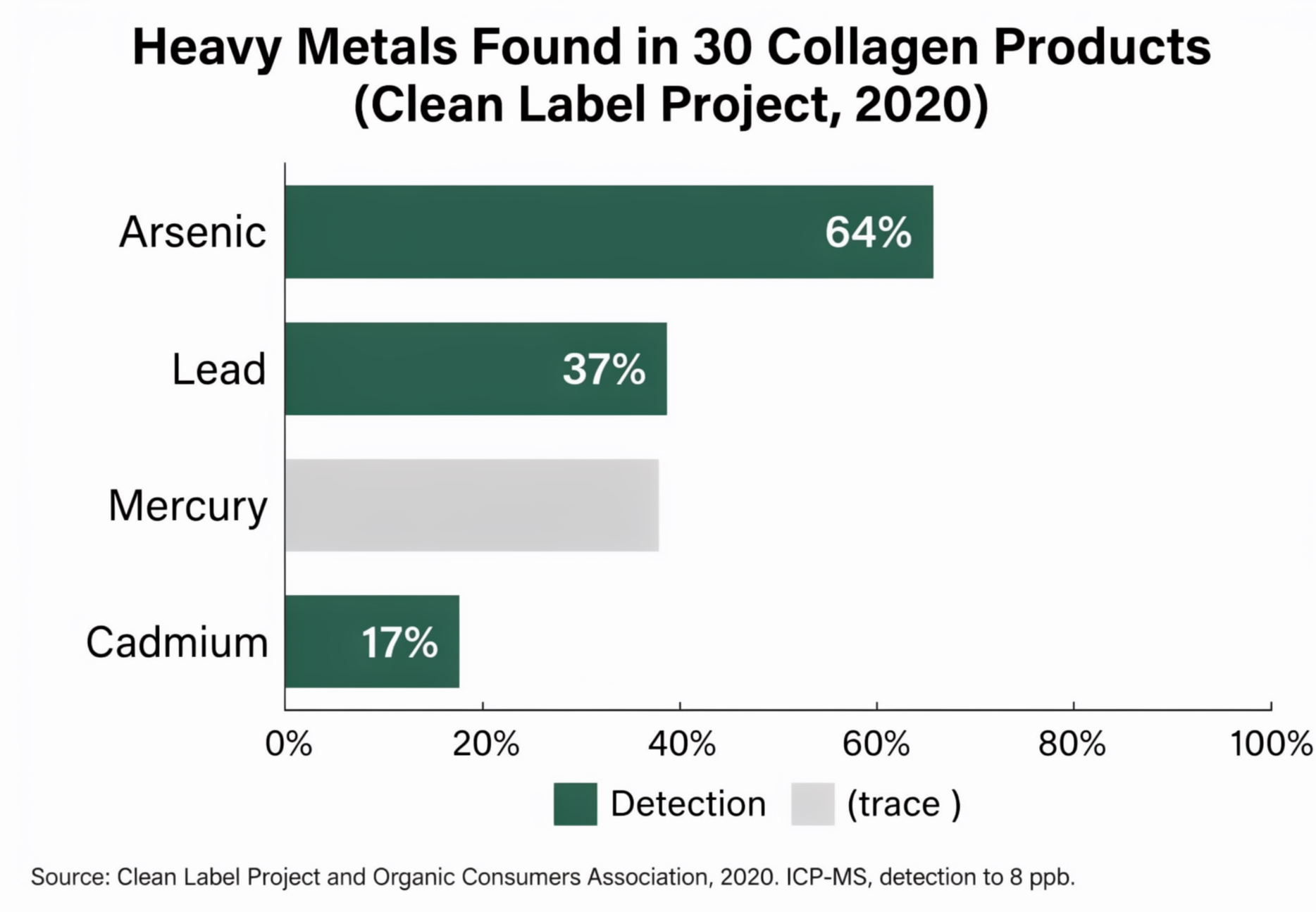
Two datasets are worth knowing. In 2020 the Clean Label Project and the Organic Consumers Association tested 30 collagen products bought on Amazon, using two independent ICP-MS laboratories with detection down to eight parts per billion. Lead was found in 37% of them, cadmium in 17%, arsenic in 64%, and mercury in roughly a third at trace levels. The highest lead result exceeded California's Prop 65 threshold by more than three times.
The tuna-relevant counterpoint is more reassuring. A 2025 study published in Open Medicine tested collagen from fish and jellyfish and found arsenic averaging 0.59 mg/kg and lead averaging 0.13 mg/kg, with mercury detectable in only 12% of samples and nothing above EU limits. The conclusion a buyer should draw is not that marine collagen is risky, but that published batch data matters more than the species on the label.
 How to Qualify a Supplier Before a Pilot Order
 How to Qualify a Supplier Before a Pilot Order
Ask for five documents before you commit to a 25 kg pilot. First, the batch COA with individual ICP-MS results for lead, cadmium, arsenic and mercury, not a single line stating the material meets a general standard. Second, the molecular weight distribution, not just the average. Third, the species and body part, since skin, scale and bone give different hydroxyproline ratios. Fourth, traceability back to the fishing area, ideally supported by a chain-of-custody standard such as MSC or Friend of the Sea. Fifth, the plant's food safety certifications: FSSC 22000, HACCP or ISO 22000 as a baseline, plus Halal and Kosher if you sell into those channels.
One practical test separates serious suppliers from the rest: ask whether the COA they send matches the lot number on the drum you receive. Batch-specific documentation for every shipment is the single strongest signal that a supplier has control of their raw material, and it is the check most often skipped.
Request a sample, COA and heavy metal panel. Contact Blue Eyes Biotech Co., Ltd. for hydrolysed marine collagen peptide specifications and batch documentation.
References
- Clean Label Project and Organic Consumers Association, collagen heavy metal testing of 30 products, 2020.
- Heavy metal content of collagen from fish and jellyfish. Open Medicine, 2025.
- California Proposition 65, maximum allowable dose level for lead, 0.5 micrograms per day.
- USP General Chapter 2232, Elemental Contaminants in Dietary Supplements.
- GB/T 22729, determination of average molecular weight for marine collagen peptides.


