


Green Tea Extract for Oily Scalp: Sebum-Control Hair Tonic Formulation
Green tea extract is investigated as a sebum-control cosmetic ingredient for oily scalp and hair tonic formulations, not as a drug for scalp disease. A small human study of a 2% green tea hair tonic reported reduced scalp sebum after 28 days, but results apply only to the tested preparation.
Formulators should verify extract specification, carrier compatibility, use level and finished-product stability, and keep claims within cosmetic boundaries. Product-specific testing is required; raw-material study data do not replace it.
Written by Blueeyes Bio Technical Content Team
Publisher: Blue Eyes Biotech Co., Ltd.
Technical scope: scalp care formulation, sebum-control evidence, cosmetic claim substantiation and raw-material qualification.
1. Why Green Tea Extract Is Studied for Oily Scalp
Oily scalp and greasy hair are common consumer concerns addressed by scalp tonics, scalp serums and leave-on scalp treatments. When developing scalp care products with green tea extract for cosmetic formulations, brands often look for botanical antioxidants that can support sebum-control positioning without relying on drug claims.
Green tea (Camellia sinensis) extract contains catechins, with epigallocatechin gallate (EGCG, CAS 989-51-5) as the major and most studied constituent. EGCG is water-soluble and is typically supplied in standardized cosmetic-grade extracts for aqueous systems. For scalp care, the ingredient is usually positioned as an antioxidant and soothing agent, while any sebum-control claim must be supported by finished-product evidence.
It is important to distinguish cosmetic care from medical treatment. Oily scalp, seborrheic dermatitis, dandruff and hair loss are different conditions; a cosmetic sebum-control ingredient is not automatically a treatment for any of them, and claims should not imply therapeutic action.
2. Clinical Evidence: 2% Green Tea Hair Tonic in a 28-Day Study
The most directly relevant published study for this application was reported by Nualsri and colleagues. The researchers developed and clinically evaluated a green tea hair tonic for greasy scalp treatment [1].
| Study Parameter | Reported Detail | Interpretation Boundary |
|---|---|---|
| Test material | Hair tonic containing 2% green tea extract. | The result applies to this specific preparation, not to every green tea extract or scalp product. |
| Study size and duration | 20 volunteers, evaluated over 28 days. | A small study; findings need confirmation in larger, product-specific trials. |
| Primary outcome | Scalp sebum measurements were significantly decreased at day 21 and day 28. | The study did not evaluate hair growth, hair loss or dandruff treatment. |
| Tolerability | Closed patch testing showed no observed skin irritation; the tonic remained stable during the study period. | Tolerability findings are specific to the tested formula; each finished product still requires its own safety and stability assessment. |
This study is useful because it evaluates a realistic hair tonic format rather than only an in vitro antioxidant assay. However, the result should not be overstated: it does not prove that the same outcome will occur in a different base, at a different concentration, or with a differently standardized extract.
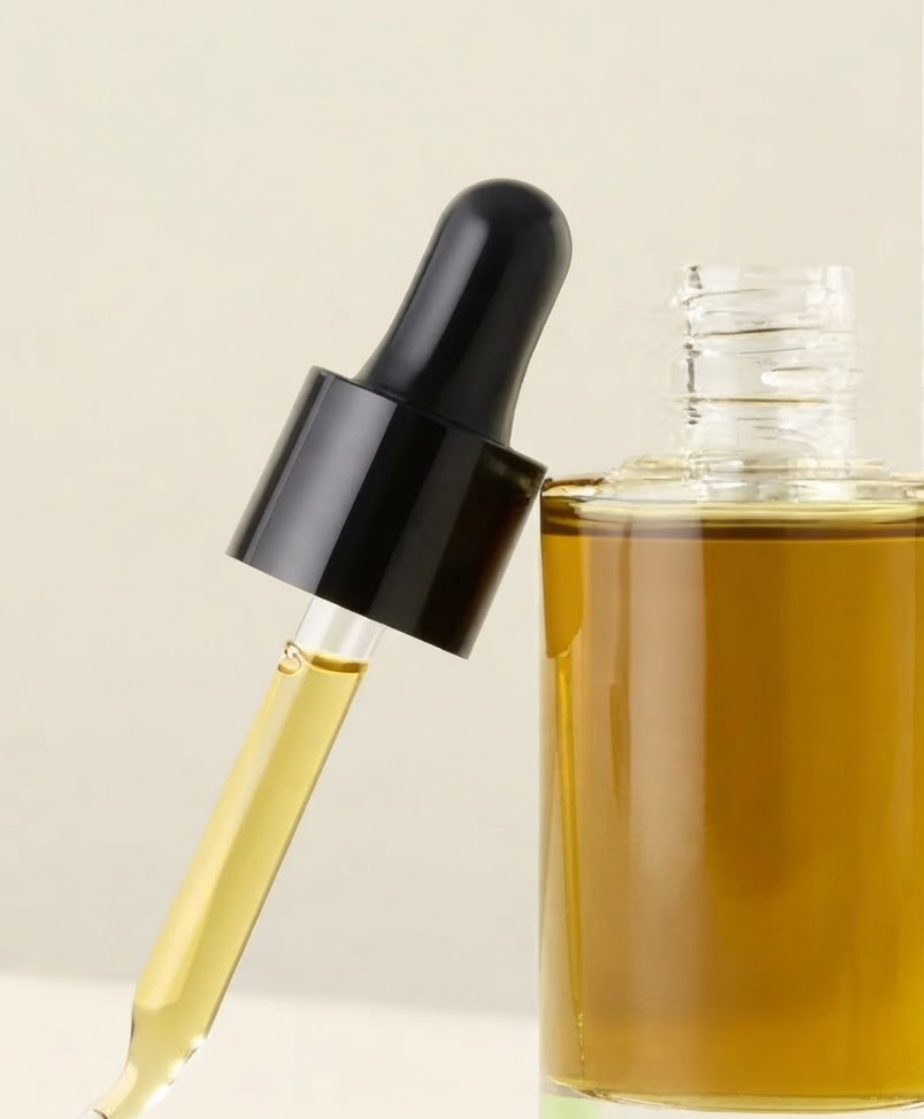
Figure 1: Green tea hair tonic and scalp serum appearance. Visual checks support physical screening but do not verify sebum-control efficacy or finished-product stability.
3. Hair Tonic Carriers and Use-Level Calculation
Scalp tonics are typically aqueous or hydro-alcoholic systems. The Nualsri study base contained glycerin and butylene glycol, with the authors reporting a total of 4% [1]. This is a useful reference point for discussing humectant-containing carriers, but it is not a universal formulation rule or a validated optimum for all scalp products.
Standard green tea extract powder is water-soluble, so it is suited to the water phase of a scalp tonic. The active catechin contribution should be calculated from the extract specification rather than assumed. Using the same reporting basis:
EGCG in formula (%) = inclusion level of the extract (%) × EGCG assay of the extract (%) ÷ 100
For example, if a scalp tonic contains 2.0% of an extract standardized to 50.0% EGCG on an as-supplied basis, the nominal EGCG contribution is 1.0% (2.0 × 50.0 ÷ 100). Final acceptance should rely on finished-product assay, because pH, packaging and processing can affect retention.
Before setting the specification, procurement teams should review how to choose cosmetic-grade green tea extract to align the grade with the intended scalp-care application and documentation requirements.
4. Stability, Preservation and Testing Requirements
Scalp tonics are water-containing products and require a suitable preservative system, pH control and packaging review. Green tea catechins can oxidize and brown under light, heat, oxygen and trace-metal exposure, so stability studies should track color, odor, pH, assay and microbiological limits over the intended shelf life.
A scalp product should be evaluated in its finished form. Useful screening includes:
- Appearance, color and odor after accelerated and real-time storage.
- pH measurement after all ingredients are incorporated.
- EGCG or total catechin retention by a validated HPLC method.
- Preservative efficacy and microbiological limits appropriate to the product type.
- Packaging compatibility, including light protection and closure performance.
Because the published study used one specific preserved tonic base, its stability and tolerability observations cannot be transferred automatically to another formulation. Each manufacturer must confirm performance in the actual product.

Figure 2: Scalp care product stability and microbial testing setup. Finished-product testing is required; raw-material study data do not replace product-specific verification.
5. Verifying the Raw Material: COA and Assay
A batch-specific COA is central to qualifying green tea extract for scalp care. Buyers should confirm that the document reports the actual lot, the test date, the product identity and the specification limits. Using green tea extract COA and assay methods to interpret the report helps ensure the result is method-defined and comparable.
| COA Item | What to Confirm | Why It Matters |
|---|---|---|
| Assay marker | EGCG, total catechins or total polyphenols, with the named analyte clearly stated. | Different methods measure different analytes; values are not interchangeable. |
| Reporting basis | Dry basis or as-supplied, with moisture result if a conversion is used. | The same material can show different percentages if the basis differs. |
| Heavy metals and microbiology | Numerical results or defined absence statements within specification. | Required for cosmetic raw-material risk control and market compliance. |
| Residual solvents | Declaration or testing when solvent-assisted extraction is used. | Supports clean-label positioning and safety review. |
6. Cosmetic Claim Boundaries
Under the EU common criteria for cosmetic claims, a claim must be supported by adequate and verifiable evidence [2]. If a formulator wants to use “sebum control,” “oil control” or “helps reduce visible scalp oil” wording, the evidence should relate to the finished product as sold, not only to a raw-material study or an in vitro assay.
The Nualsri study provides supportive background for a 2% green tea hair tonic, but a brand making a sebum-control claim should still confirm the effective concentration in its own base and conduct product-specific testing. Claims that imply treatment or prevention of dandruff, seborrheic dermatitis, hair loss or scalp disease would move the product toward medicinal or drug claims and require a different regulatory pathway.
Finished cosmetic products must also comply with the general safety requirements of Regulation (EC) No 1223/2009 [3]. A cosmetic scalp tonic should be assessed for safety, stability and labeling before market launch.
7. Buyer and QA Checklist for Scalp-Care Projects
- Define the scalp product format: hair tonic, scalp serum, leave-on treatment or rinse-off product.
- Confirm the extract specification: EGCG or catechin assay, reporting basis, moisture and physical form.
- Set the inclusion level and calculate the nominal active contribution from the COA assay.
- Select a carrier system and confirm green tea extract solubility and compatibility.
- Plan finished-product stability, preservative efficacy, microbiological and packaging testing.
- Keep claims within cosmetic boundaries; attribute sebum-control wording to finished-product evidence.
- Verify sample-to-bulk identity and agree change-notification expectations with the supplier.
Request Sample and Batch COA for Scalp-Care Formulation
Share your scalp-care product format, target catechin specification and intended inclusion level. Ask about a green tea extract sample, current batch COA, HPLC assay documentation and stability support for hair tonic or scalp serum screening.
Sample quantity, charges, shipping, stock status and documentation availability require confirmation for the selected grade.
Request Scalp-Care Sample via WhatsApp
Email: [email protected]
Frequently Asked Questions
Can green tea extract cure dandruff or hair loss?
No. The available cosmetic study evaluated sebum control in a 2% green tea hair tonic over 28 days in 20 volunteers; it did not establish treatment of dandruff, seborrheic dermatitis or hair loss. Such claims would be medicinal or drug claims and require a different evidence and regulatory pathway.
What concentration of green tea extract was used in the oily scalp study, and does it guarantee the same result in my formula?
The study used 2% green tea extract in a hair tonic base and reported reduced scalp sebum at days 21 and 28. This does not guarantee the same result in another formula; finished-product performance depends on the extract specification, base, concentration, application frequency and product-specific testing.
How should I verify a green tea extract for scalp care products?
Request a batch-specific COA with identity, EGCG or total catechin assay, reporting basis, moisture, heavy metals, microbiological limits and residual solvents. Confirm the assay method is suitable for the botanical matrix, then verify that the evaluated sample matches the commercial grade you intend to purchase.
References and Evidence Limits
[1]Nualsri, et al. “Development and clinical evaluation of green tea hair tonic for greasy scalp treatment.” Journal of Cosmetic Science. PubMed.
[2]Regulation (EU) No 655/2013 laying down common criteria for the justification of claims used in relation to cosmetic products.
[3]Regulation (EC) No 1223/2009 on cosmetic products.
Evidence limitation: The clinical study cited used a specific 2% green tea extract hair tonic in 20 volunteers over 28 days. Results do not verify the performance of any Blueeyes Bio batch or of a customer’s finished scalp product, and they do not support drug-type claims for dandruff, seborrheic dermatitis or hair loss. Cosmetic sebum-control claims must be substantiated on the finished product according to applicable market regulations.
Technical Summary
Blueeyes Bio’s oily-scalp framework treats green tea extract as a cosmetic sebum-control adjunct studied in a 2% hair tonic, not as a drug active. Qualified development requires a defined extract specification, aqueous carrier compatibility, calculated active contribution, finished-product stability and preservation testing, and claim substantiation under Regulation (EU) No 655/2013. The 20-volunteer, 28-day study is supportive background only and must not be overstated as a guarantee of efficacy.


